
§ How-To
How to Mount Battery Holders in a Garage, Trailer, or Truck
Show the best mounting approaches for walls, pegboards, shelves, and mobile setups. Include guidance on orientation, vibration concerns, and safety around battery storage.
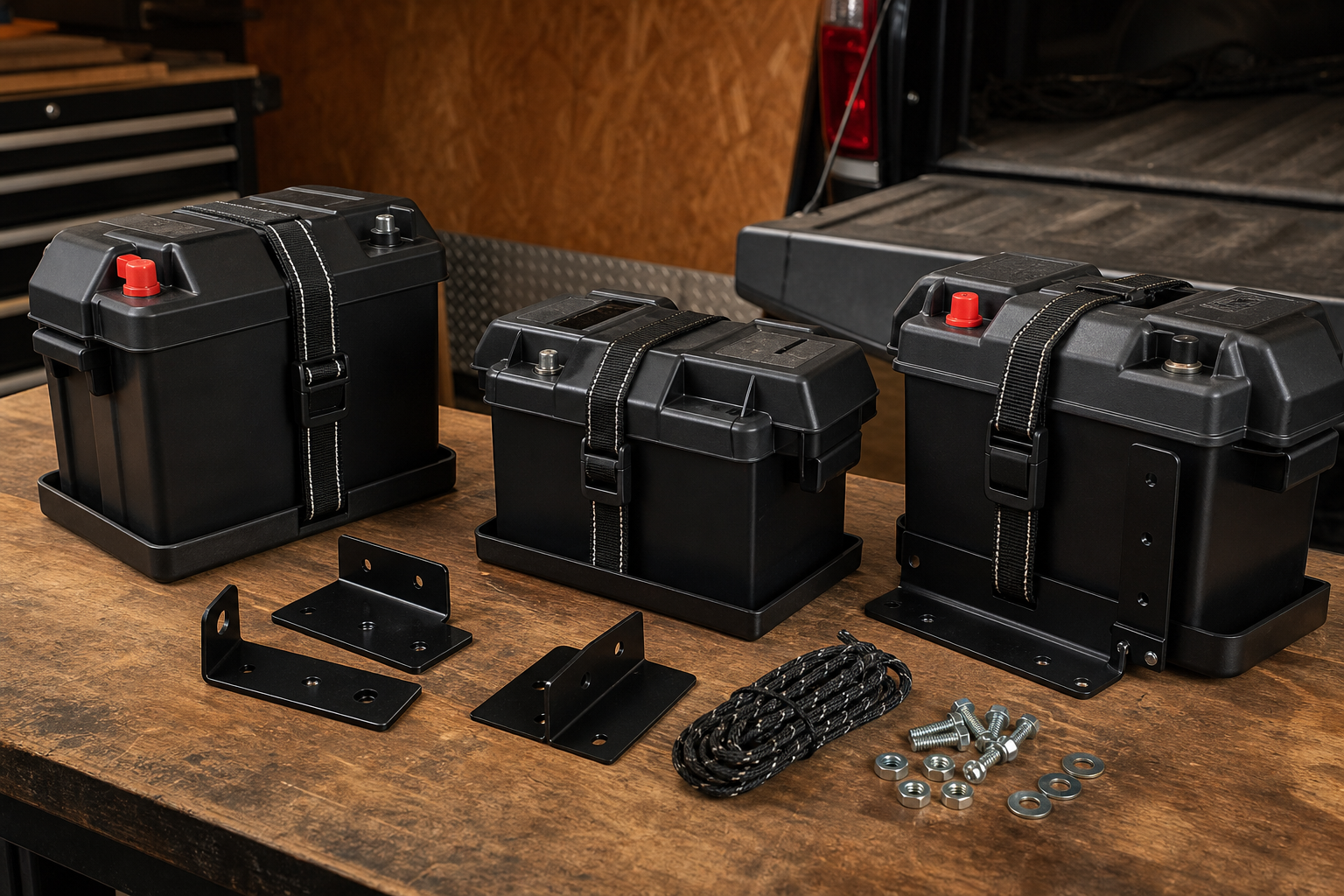
A good battery holder does two jobs at once: it keeps cordless tool batteries organized, and it protects expensive packs from getting knocked around, shorted, or lost in the shuffle. Whether you’re setting up a garage wall, a service trailer, or the back of a work truck, the mounting method matters just as much as the holder itself. The best setup depends on where it’s going, how much vibration it sees, and how quickly you need to grab and return batteries during real work.
Choose the Right Mounting Surface and Hardware
Before you screw anything down, look at the surface behind the holder. Battery packs are heavier than they look, especially when you line up several 4Ah, 5Ah, or high-output packs in one row. A holder mounted into weak material will loosen over time.
For garage walls, the strongest option is fastening directly into wall studs or into solid plywood backing. If your wall is finished with drywall only, avoid relying on drywall anchors for multi-battery storage unless the holder is carrying very light loads. A better approach is to screw a strip of 18mm plywood across two studs, then mount the holders to that. It spreads the load, gives you more placement options, and makes future changes easier.
For pegboards, treat them as a light-duty organization surface unless they’re metal shop-grade panels. Standard fiber pegboard can flex if you load it with several battery packs. If you want the convenience of pegboard layout, reinforce the mounting area with a backer plate or move battery storage to a fixed rail or shelf mounted nearby.
For shelves and under-shelf mounting, use short wood screws into solid shelf material, not just thin laminate. Under-shelf mounts work well when you want batteries tucked out of the way but still visible. Check shelf thickness first so screw tips do not break through the top surface.
For trailers and trucks, vibration changes the rules. Use machine screws with washers and lock nuts where you can access both sides. If you must mount into sheet metal or thin wall panels, use rivet nuts or structural backing plates rather than simple self-tappers. Self-drilling screws are quick, but in mobile setups they can loosen over time unless the base material is solid.
A simple rule: the rougher the ride, the stronger and more mechanical the fastening should be.
Best Mounting Approaches for Walls, Pegboards, and Shelves
A clean layout saves time and helps batteries last longer because they’re less likely to be dropped or left in bad spots.
On a garage wall, mount holders at chest to eye level where labels are easy to read and packs can be inserted and removed without twisting your wrist. Leave enough clearance above and below each holder for the battery to slide in and out fully. If you’re mounting several brands or battery platforms, group them by voltage and tool family. That prevents mix-ups when you’re in a hurry.
On pegboard, keep only the batteries you use most often, and avoid loading one small section with too much weight. Space the holders so your hand can wrap around each battery without bumping the next one. If the pegboard vibrates when batteries are removed, it’s overloaded or under-supported.
For shelf mounting, there are two practical styles:
- Top-of-shelf mounting, where holders are fixed on the shelf surface for maximum support
- Under-shelf mounting, where batteries slide upward or sideways into holders to free up bench space
Under-shelf mounting works especially well above a charger station, but pay attention to orientation. If the holder relies on the battery’s slide rail and friction fit, mount it exactly as intended by the holder design. Don’t assume every holder is suitable for upside-down use. Some are designed for vertical wall mounting but not for inverted mounting with heavier packs.
A good workshop trick is to leave one open section for incoming batteries that need charging and another for charged packs. That keeps your rotation organized and prevents grabbing a flat battery by mistake.
Orientation, Vibration, and Mobile Setup Tips
Orientation matters more in trailers and trucks than in a fixed garage. In a stationary space, vertical wall mounting is usually fine if the holder has a positive locking fit. In a mobile setup, you want gravity and vibration working in your favor, not against you.
For trailers, side-wall mounting can work if the holder locks the battery securely and the trailer is reasonably well-sprung. For rougher conditions, mount holders on a bulkhead, inside a cabinet, or on a rack with a retaining lip or strap. A battery that feels snug in the shop can bounce loose after a few hundred kilometers on uneven roads.
For trucks, avoid mounting batteries where they’re exposed to direct sun through rear glass, constant dust, or impact from shifting cargo. Inside a service canopy, enclosed drawer unit, or partitioned cabinet is usually best. If batteries are mounted openly in a ute tray or van cargo area, add a secondary retention method such as a rubber strap, latch bar, or enclosed bracket.
A few practical anti-vibration measures:
- Use nyloc nuts, lock washers, or threadlocker on fasteners
- Recheck fasteners after the first week of use
- Avoid long unsupported rows of holders on thin panels
- Use rubber or nylon washers if you need to reduce rattling between bracket and surface
- Keep heavy high-capacity packs lower and closer to structural supports
If you’re carrying batteries daily, do a quick shake test after installation. Insert the packs, then simulate road vibration by hand. If there’s movement, improve the mounting before trusting it on the road.
Battery Storage Safety and Placement
Battery holders organize packs, but they are not a substitute for safe battery storage practices. Store batteries in a dry, cool area, away from direct heat sources, fuel containers, weld spatter, and metal offcuts that could bridge contacts. A holder should keep the battery’s terminals protected and prevent loose packs from sliding around in a drawer or bin.
Don’t mount battery holders directly above a grinder, vise, or cutting station where sparks and metal filings are common. Fine conductive debris is bad news around battery contacts and charger terminals. Likewise, avoid damp exterior walls with condensation issues.
Inspect packs before storing them. Don’t put a cracked, swollen, or impact-damaged battery back into your main storage rack. Isolate it safely and follow the manufacturer’s disposal or service guidance.
For mixed garage use, keep chargers and holders close but not crowded. Chargers need ventilation. Batteries waiting for use do not need to be baked beside transformers and power supplies. A little spacing helps both safety and battery life.
FAQ
What is the best orientation for battery holders?
For most garages, vertical wall mounting is the most practical if the holder is designed for it. For trailers and trucks, use the orientation recommended by the holder maker and favor setups with a positive locking fit plus secondary retention if vibration is high.
Can I mount battery holders to pegboard?
Yes, but only for lighter-duty use unless the pegboard is reinforced or metal-backed. Standard pegboard alone is usually not the best long-term choice for a row of heavy cordless tool batteries.
Is it safe to store batteries in a trailer or truck full-time?
It can be, if they’re mounted securely, kept dry, protected from impact, and not exposed to extreme heat. Avoid leaving batteries in direct sun or sealed hot vehicle compartments for long periods, especially in summer.
Find the right part on Amazon
Check price, stock and fitment — ships direct from Amazon.
§ Catalog
Shop the catalog


